
Starlink by StateRural internet, state by statePrice Starlink at my address ↗Referral link · $100 to first-time US buyers · we earn the same
Starlink ↗Referral link to starlink.com: Starlink credits first-time US buyers $100 two months into service, and we earn a matching reward.

BEAD, explained simply

Is fiber coming to your rural home?

The $42.45 billion BEAD program has picked a provider and a technology for about 3.79 million homes and businesses. Here's how to find out if yours is one of them, what you'll get, and when.

By Starlink by StateFacts checked November 3, 2026How we check

A two-lane road lined by wooden utility poles and wires, leading toward green rolling hills
A country road off Interstate 5 in central California. Photo: Carol M. Highsmith, Library of Congress, Public domain.
In brief

By August 25, 2026, NTIA had approved every state's BEAD plan. Across the country, about 62.9% of funded locations will get fiber, 21.9% low-orbit satellite, 13.3% fixed wireless and 1.9% cable. To see your own result, open your state's BEAD award map or list (linked from your state guide) and look up your address. Funded wired providers have up to four years from their grant to start service.

What is BEAD, in one minute?

  • Who runs it: the National Telecommunications and Information Administration (NTIA) gave each state a share of $42.45 billion; each state broadband office chose the winning providers.
  • Who it's for: homes and small businesses that the FCC map and the state's challenge process showed as lacking reliable broadband.
  • What changed in 2025: NTIA's June 2025 rules made the program "technology neutral", dropping the old fiber preference, so states could award locations to fixed wireless and low-orbit satellite as well as fiber. The notice tells states to pick the option "with the lowest cost based on minimal BEAD Program outlay."
  • Where it stands: about $18.19 billion is going to construction across all states and territories, according to Broadband Breakfast's tally of the approved plans.
BEAD pays companies, not households

BEAD money goes to states, which give grants to providers to build or upgrade networks. Nobody gets a BEAD check. When service reaches you, you choose whether to sign up and you pay a monthly bill.

What does BEAD mean for your address?

  1. Open your state guide

    Pick your state on the states page. Each guide links to that state broadband office's BEAD page and, where one exists, its public award map or list.

  2. Search your address or county on the award map

    Most states show funded locations as dots or areas, colored by provider or technology. Some publish a spreadsheet by county instead.
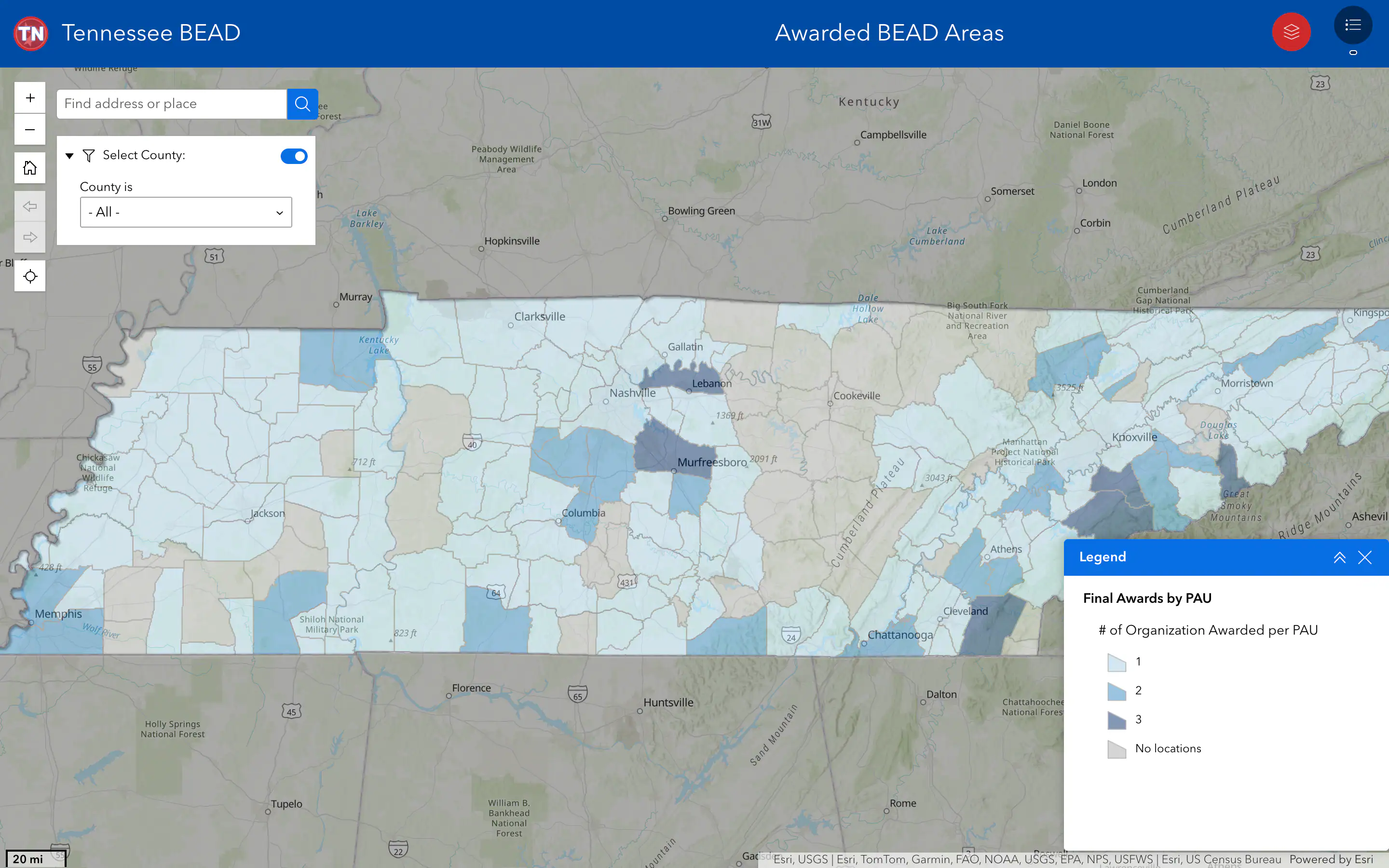
    Tennessee "Awarded BEAD Areas" map: the state split into project areas shaded by how many providers won BEAD awards in each, with the legend open
    1. Awarded BEAD Areas map
    2. Search your address or town
    3. Legend: number of providers awarded per area
    Open your state broadband office's BEAD awards map (Tennessee shown) and find your county. Screenshot of experience.arcgis.com, November 3, 2026.
  3. Read three things: provider, technology, status

    Click your location. Note who won it, whether it's fiber, fixed wireless or satellite, and any status or completion date.
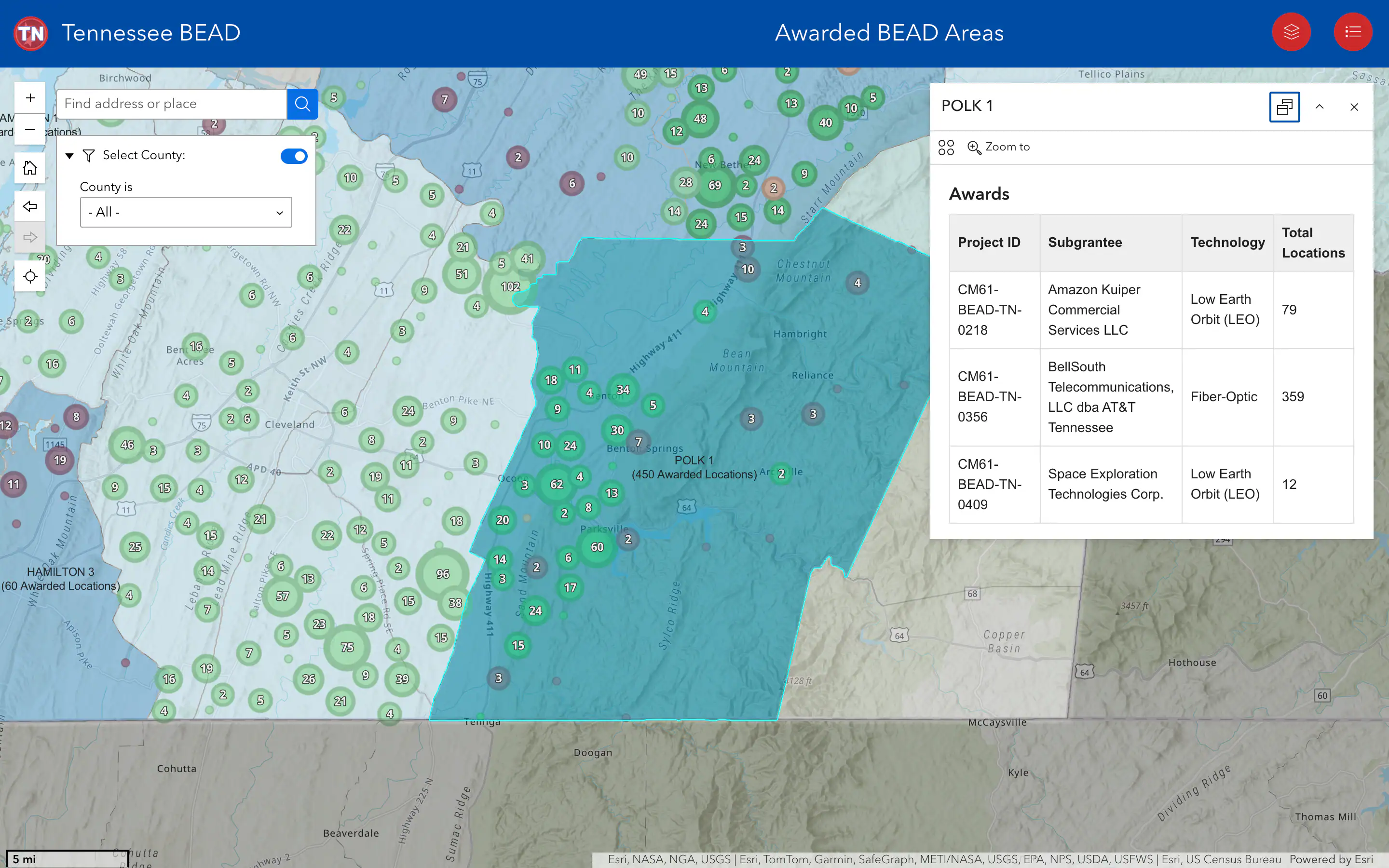
    Tennessee BEAD awards map zoomed to project area "POLK 1" in Polk County with its popup listing three awards: Amazon Kuiper (low-earth-orbit satellite, 79 locations), AT&T Tennessee (fiber, 359) and SpaceX (low-earth-orbit satellite, 12)
    1. Satellite award: Amazon Kuiper, 79 locations
    2. Fiber award: AT&T, 359 locations
    3. Satellite award: SpaceX (Starlink), 12 locations
    Zoom in to your area and click it: the box lists who won the BEAD award there, the technology (fiber or satellite) and how many locations it covers. Screenshot of experience.arcgis.com, November 3, 2026.
  4. Ask the provider for its schedule

    Call the winning provider with your address and ask when construction reaches your road. Co-ops often publish phase maps.

  5. Not on the list?

    Your address may already have qualifying service on the FCC map, or it may be in a different program. Check the FCC map and the co-ops in your state guide.

When will it be built?

Federal law says a BEAD-funded provider must build and begin service to every customer who wants it within four years of receiving its subgrant, with limited extensions. So a provider that signed its subgrant in 2026 has until 2030, though many will finish sooner, especially where they're already building nearby. Your state guide shows any build schedule your state has published.

Our rule of thumb: wait and compare

If fiber is funded for your address and the provider expects to reach you within about a year, avoid long contracts and expensive equipment. Use a month-to-month option until it arrives, then compare.

What if your location went to satellite?

Low-orbit satellite providers (SpaceX's Starlink and Amazon's Leo) won about a fifth of BEAD locations nationally, mostly the most remote and costly ones. According to the Benton Institute's reading of NTIA's 2025 rules, a satellite provider funded by BEAD must offer those locations free equipment for the 10-year service period and keep enough network capacity for them. How you sign up as a funded location varies, so ask your state broadband office before you buy equipment yourself.

Satellite awards are being trimmed in 2026

In July 2026 NTIA sent states lists of satellite locations to remove, saying newer FCC map data showed some were sheds or barns rather than homes, or already had wired service. Broadband Breakfast reported states could be asked to remove "as many as half" of their satellite locations. States can challenge removals, and many contracts were still being negotiated, so check your state's latest list.

How to get fiber built to your road

  1. Pre-register with your electric or telephone co-op

    Some co-ops build first where the most members sign up. Your state guide lists co-ops building fiber.

  2. Collect your neighbors

    A simple sheet of names, addresses and "would subscribe" helps a provider see the demand on your road.

  3. Send it to the right people

    The provider or co-op first, then your county and your state broadband office. If your road is private, get the owners' written permission for poles or trenching ready.

  4. Fix the map

    If the FCC map wrongly shows your home as served, challenge it. Homes shown as served are skipped by grant programs.

Lower-cost plans

Every BEAD-funded provider must also offer at least one low-cost service option to eligible households. Your state broadband office can tell you who qualifies and how to apply.
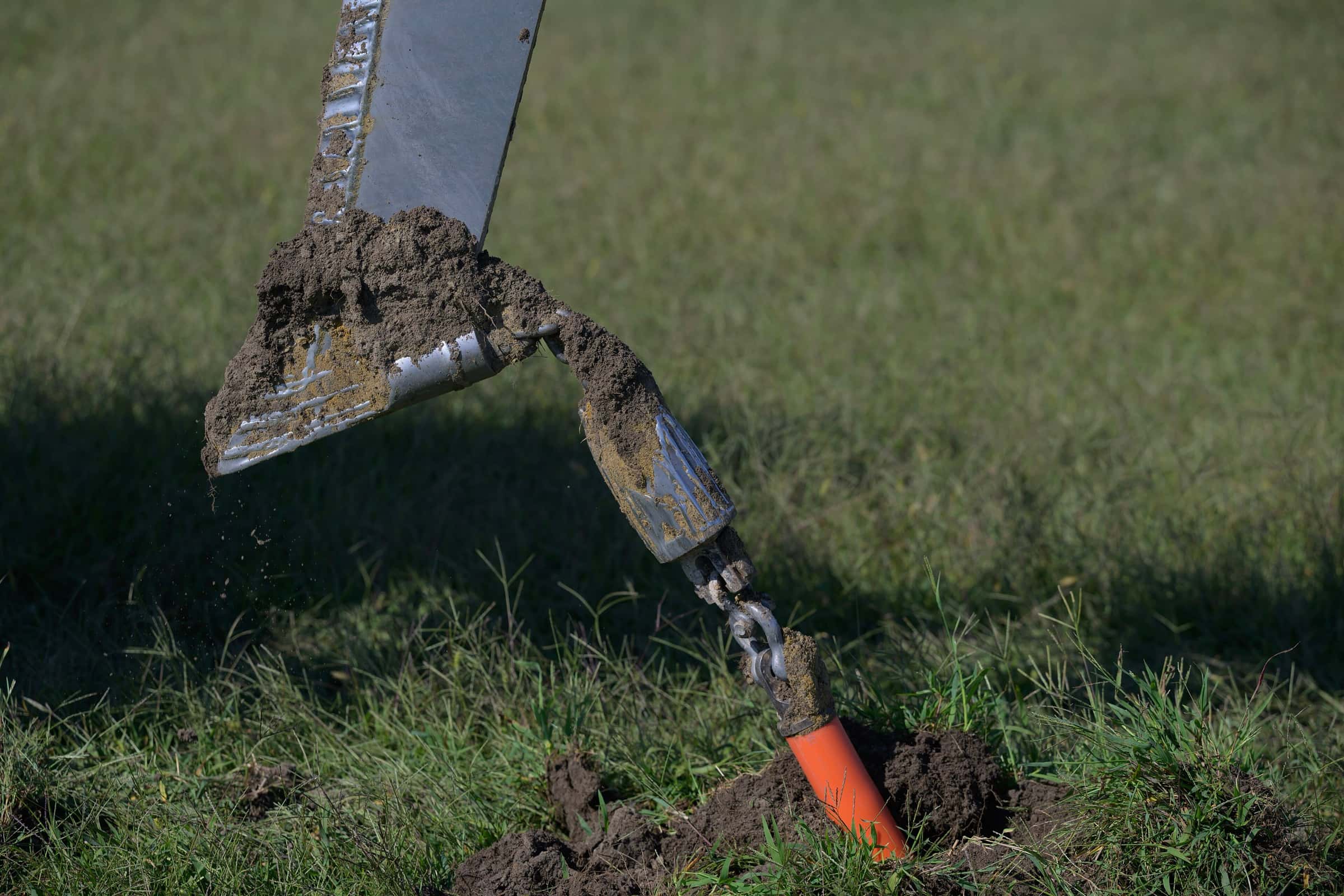
Close-up of a steel plow blade pulling orange conduit into the ground through a grass field
A vibratory plow burying conduit for fiber-optic cable, Cordova, Maryland. Photo: USDA photo by Christophe Paul, Public domain.

State BEAD maps and lists

Where to look up BEAD results, by state
StateBEAD resultsFunded locations
AlabamaAlabama Digital Expansion Division, Alabama Department of Economic and Community Affairs (ADECA)94,555
AlaskaAlaska Broadband Office, Alaska Department of Commerce, Community, and Economic Development46,508
ArizonaArizona State Broadband Office, Arizona Commerce Authority161,648
ArkansasArkansas State Broadband Office (ARConnect), Arkansas Department of Commerce79,293
CaliforniaCalifornia Public Utilities Commission (CPUC), Broadband Implementation for California270,571
ColoradoColorado Broadband Office (CBO), Governor's Office of Information Technology96,065
ConnecticutOffice of Telecommunications and Broadband, Connecticut Department of Energy and Environmental Protection (DEEP)1,782
DelawareDelaware Broadband Office, Department of Technology and Information (DTI)4,739
District of ColumbiaDC State Broadband Office (DC SBO), Office of the Chief Technology Officer (OCTO)101
FloridaFloridaCommerce Office of Broadband73,944
GeorgiaGeorgia Technology Authority (Georgia Broadband Program)119,814
HawaiiUniversity of Hawaiʻi Broadband Office (UHBO)7,033
IdahoIdaho Office of Broadband (Link Up Idaho)91,341
IllinoisIllinois Office of Broadband (in the Illinois Department of Commerce and Economic Opportunity)142,416
IndianaIndiana Broadband Office (IBO)122,847
IowaIowa Department of Management, Division of Information Technology (Broadband)37,634
KansasKansas Office of Broadband Development (Kansas Department of Commerce)26,613
KentuckyKentucky Office of Broadband Development87,160
LouisianaLouisiana Office of Broadband Development and Connectivity (ConnectLA)127,108
MaineMaine Connectivity Authority (MCA)22,513
MarylandOffice of Statewide Broadband (Maryland Department of Housing and Community Development)9,771
MassachusettsMassachusetts Broadband Institute (MBI) at the Massachusetts Technology Collaborative (MassTech)3,808
MichiganMichigan High-Speed Internet Office (MIHI), Michigan Department of Labor and Economic Opportunity197,964
MinnesotaMinnesota Office of Broadband Development (Department of Employment and Economic Development, DEED)74,739
MississippiBroadband Expansion and Accessibility of Mississippi (BEAM), Department of Finance and Administration93,283
MissouriMissouri Office of Broadband Development (Department of Economic Development)204,366
MontanaMontana Broadband Office (ConnectMT), Montana Department of Administration68,498
NebraskaNebraska Broadband Office (NBO)14,064
NevadaGovernor's Office of Science, Innovation and Technology (OSIT), High Speed Nevada Initiative26,236
New HampshireOffice of Broadband Initiatives, NH Department of Business and Economic Affairs (BEA)5,135
New JerseyOffice of Broadband Connectivity (OBC), New Jersey Board of Public Utilities11,479
New MexicoOffice of Broadband Access and Expansion (OBAE)42,651
New YorkConnectALL Office (Empire State Development)52,982
North CarolinaNCDIT Division of Broadband and Digital Opportunity (N.C. Department of Information Technology)93,437
North DakotaNorth Dakota Information Technology (NDIT) Broadband program279
OhioBroadbandOhio (Ohio Department of Development)83,992
OklahomaOklahoma Broadband Office (OBO)40,509
OregonOregon Broadband Office (Business Oregon)104,654
PennsylvaniaPennsylvania Broadband Development Authority (PBDA)129,356
Rhode IslandRhode Island Commerce Corporation – ConnectRI2,622
South CarolinaSouth Carolina Broadband Office (SCBBO), within the Office of Regulatory Staff (ORS)20,480
South DakotaSouth Dakota Broadband Office (SDBO), Governor's Office of Economic Development (GOED) - ConnectSD7,060
TennesseeTennessee Department of Economic and Community Development (TNECD) Broadband Office43,871
TexasTexas Broadband Development Office (BDO), Texas Comptroller of Public Accounts242,903
UtahUtah Broadband Center (a division of the Utah Department of Transportation)30,215
VermontVermont Community Broadband Board (VCBB), Department of Public Service15,299
VirginiaVirginia Office of Broadband, Department of Housing and Community Development (DHCD)85,069
WashingtonWashington State Broadband Office (WSBO), Department of Commerce166,564
West VirginiaWest Virginia Office of Broadband (WV Department of Commerce, Division of Economic Development)73,091
WisconsinWisconsin Broadband Office (Public Service Commission of Wisconsin)175,464
WyomingWyoming Business Council Broadband Office (WBO)38,558

Rural internet questions, answered

What is BEAD?

The Broadband Equity, Access, and Deployment program is a $42.45 billion federal program, run by NTIA, that pays internet providers to connect homes and businesses that lack good internet. Each state picked the providers and technologies for its locations, and NTIA had approved every state's final plan by August 25, 2026.

How do I know if my address is getting fiber from BEAD?

Open your state broadband office's BEAD results (each state guide on this site links to it) and search for your address or look at the award map for your county. It shows which provider won your location and with which technology.

When will BEAD fiber be built?

The law gives each funded provider up to four years from the date it receives its subgrant to build and start service, and states can extend that in some cases. A provider that signed its subgrant in 2026 has until 2030. Many will finish sooner, so ask the provider for its schedule for your road.

My address is a BEAD satellite location. What does that mean?

Your state decided a low-orbit satellite provider (usually SpaceX's Starlink or Amazon's Leo, formerly Project Kuiper) would serve your location with BEAD money instead of a wired network. According to analysis of NTIA's June 2025 rules, BEAD satellite providers must offer funded locations free equipment for the 10-year service period. Ask your state broadband office how sign-up for funded locations works before buying equipment yourself.

Should I wait for BEAD fiber or get something now?

If fiber is funded for your address and due within about a year, it usually pays to wait and use a month-to-month option meanwhile. If it is years away or not funded at all, pick the best option available today.

My home was missed by BEAD. Is there anything else coming?

Possibly. Many electric and telephone co-ops build fiber with other grants (for example USDA ReConnect or state programs). Each state guide lists co-ops and programs we found for that state.

Where these figures come from

  1. With All BEAD Plans Approved, States and Territories Set to Spend $18.2 Billion on Deployment (Broadband Breakfast, Aug. 28, 2026) (November 3, 2026)
  2. All states and territories secure approvals from NTIA on BEAD final proposals (StateScoop, Aug. 26, 2026) (November 3, 2026)
  3. 47 U.S.C. § 1702(h)(4)(C): deploy and begin service within 4 years of the subgrant (Cornell LII) (November 3, 2026)
  4. What Do We Know About LEO BEAD Bids? (Benton Institute, June 12, 2025) (November 3, 2026)
  5. NTIA: Broadband Equity, Access, and Deployment (BEAD) Program
  6. NTIA BEAD Restructuring Policy Notice, June 6, 2025 (copy hosted by Arkansas State Broadband Office)
  7. Satellite BEAD Awards to be Reduced (Broadband Breakfast, July 14, 2026) (November 3, 2026)