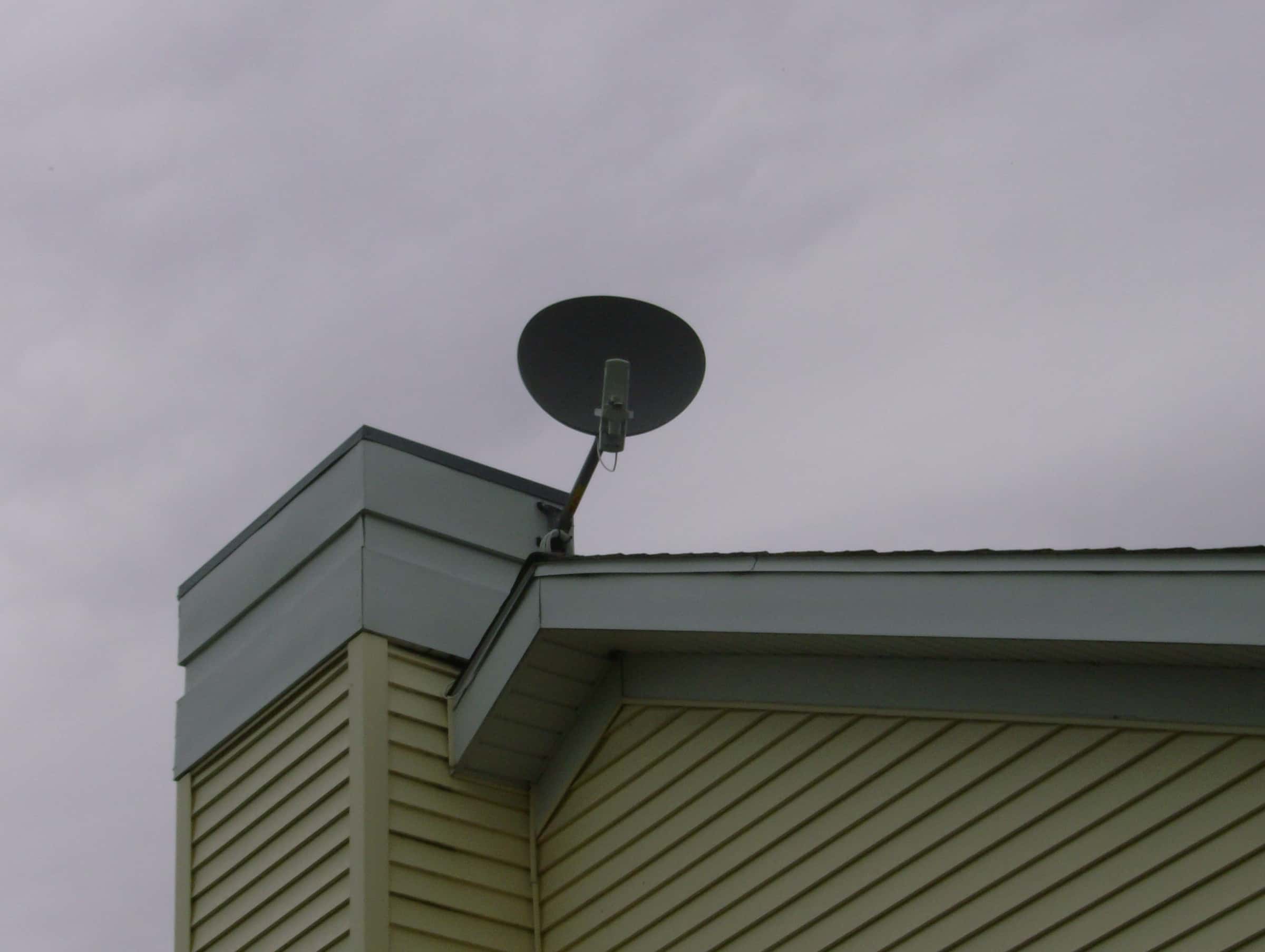

If your phone gets a strong signal inside your house, or a local provider can see your roof from its tower, fixed wireless or 5G home internet is often the cheapest good option in the country, with low delay and no dish to aim. It struggles with hills, thick trees and busy evening towers. It's also a big part of BEAD: about 13.3% of funded locations will get fixed wireless.
Two kinds of tower internet
Local fixed wireless
A small antenna on your house points at the provider's tower. Many rural providers ("WISPs") are local businesses or co-ops.
5G or 4G home internet
A gateway box by a window uses the mobile carrier's cell towers. No installer, usually no contract.
Will it work at your house? Five easy checks
Look for wireless providers on the FCC map
On the FCC map, fixed wireless shows as "licensed" or "unlicensed fixed wireless". Note every one listed.
Run each carrier's own address check
5G home internet is sold only where a tower has room: check T-Mobile, Verizon and AT&T Internet Air with your address.
Test your phone at the best window
Stand where the gateway would sit, ideally an upstairs window facing the nearest tower. Three or more bars, and a phone speed test that's steady at 8–9 p.m., is a good sign.
Ask a local provider for a site survey
Most local wireless providers will check line of sight from their tower to your roof for free. Ask about pole mounts if trees are in the way.
Use the trial or return window
Ask how many days you have to return the equipment without a fee, and test it during the busy evening hours before you cancel anything else.
Carriers sell 5G home internet address by address, only where the tower serving you has spare room, and the gateway is registered to your address, so moving it can stop it working. An address can be refused, or put on a waitlist, even when phones work fine there.
Weak signal indoors? Try the gateway in an upstairs window facing the tower first. A signal booster or outdoor antenna only helps if there's some usable signal outside the house to begin with.
Where it shines, where it doesn't
Good fit
- Open farmland or a hilltop with a view of a tower
- A strong phone signal indoors
- Light to medium use, or a tight budget
Poor fit
- Deep valleys, thick forest, or a hill between you and the tower
- Several people streaming and working at once on a busy tower
- Homes far from any tower
If no tower reaches you
Where neither wired service nor a good wireless signal reaches, low-orbit satellite is usually the next-best choice for a year-round home.
- A funded fiber or cable build covers your address (BEAD or a co-op project) and should arrive within about a year: hold off and compare. How to check.
- Trees, a ridge or nearby buildings hide most of your sky and there's nowhere to mount the dish above them.
- The need is seasonal or short: one stay, one trip, one job. Starlink is a monthly subscription meant to stay on.