

33.3% of North Carolina residents live in rural areas, the 17th highest share among the 50 states and DC. 78.3% of households have a wired plan (US: 76.6%) and 6.9% use satellite internet, close to the US average of 6.9%. North Carolina's BEAD plan will connect 93,437 homes and businesses: 63% fiber, 1% fixed wireless, 35% satellite.
Best move: the FCC map first, then North Carolina's BEAD results.
- Rural residents
- 33.3%3,474,661 people · 2020 Census
- Homes on satellite
- 6.9%US: 6.9% · ACS 2025
- Homes with no internet
- 5.9%US: 6.0% · ACS 2025
- BEAD allocation
- $1.53B$1.53 billion · NTIA, June 2023
- BEAD locations
- 93,437as of December 2025
Getting the best internet in North Carolina: step by step
See every provider at your address
Search it on the FCC National Broadband Map and note any fiber, cable or fixed wireless provider; 78.3% of North Carolina homes already have a wired plan. Screenshot guide.
Check whether BEAD funded your location
Open North Carolina's BEAD results. NCDIT's public 'NC BEAD Award Map': type your address in the search bar, then click your location's point to see the BEAD provider and project chosen for it; it also has county and provider filters.
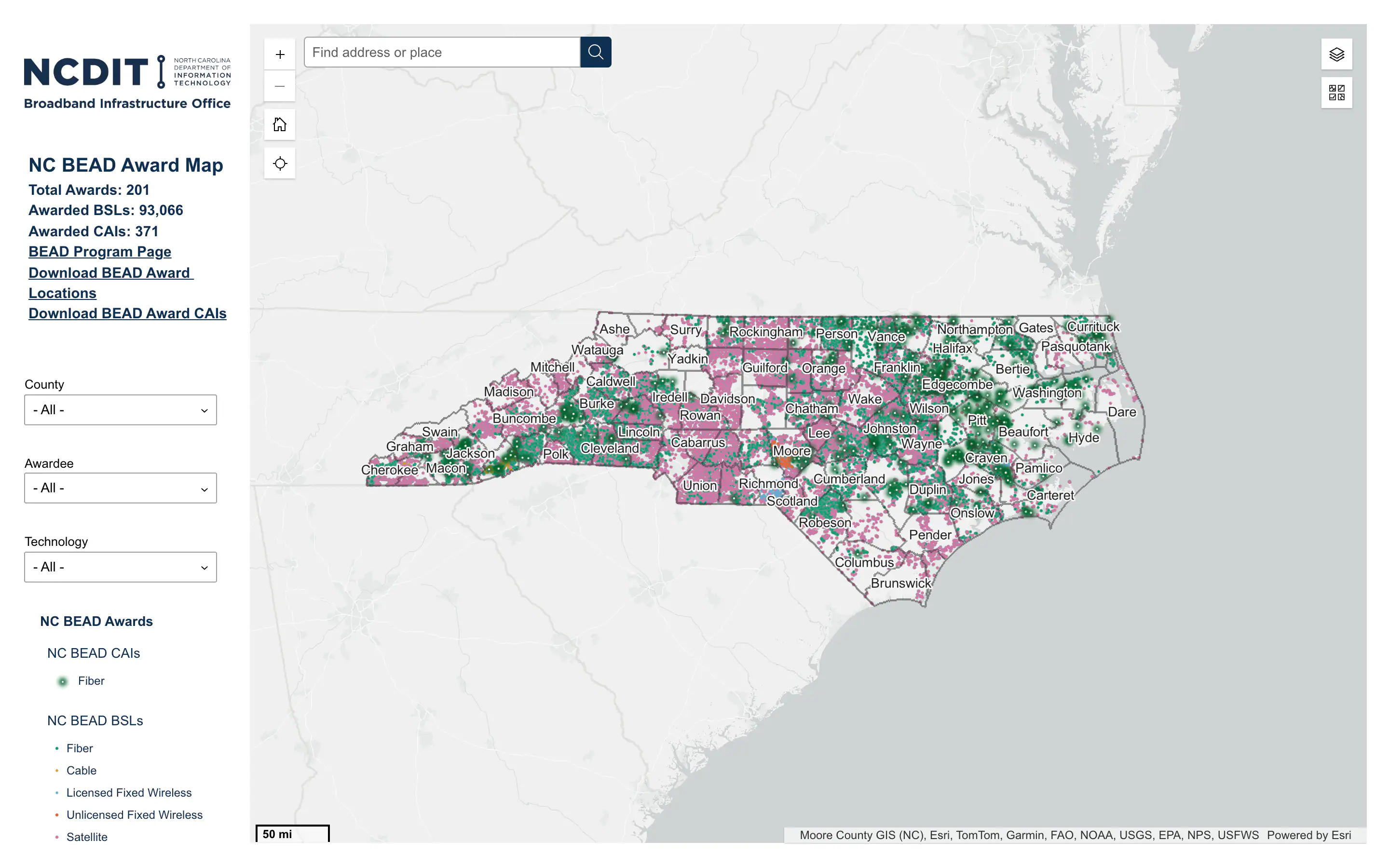
- Find address or place
- Filter by county, awardee or technology
- Dot colors: fiber, cable, fixed wireless, satellite
Open the NC BEAD Award Map, type your address in "Find address or place", then click the dot on your home to see the provider. Screenshot of experience.arcgis.com, November 3, 2026. Check co-op and local fiber
Start with Randolph Communications (Randolph Telephone Membership Corporation, RTMC) and Zirrus (Yadkin Valley Telephone Membership Corporation, formerly Yadtel) and run each one's address check. All 3 local builders we found.
Test the tower signal
11.8% of North Carolina households get by on cellular data alone (US: 13.1%). 5G home and fixed wireless checks.
North Carolina BEAD program: is fiber coming?
NTIA gave North Carolina $1.53 billion from the BEAD program in June 2023. NTIA approved the state's final plan on December 19, 2025. The plan puts about $318.7 million into construction. It covers 93,437 locations (data as of December 18, 2025):
- Fiber 59,224 (63%)
- Fixed wireless 1,339 (1%)
- Satellite 32,292 (35%)
- Cable & other 582 (1%)
North Carolina leans on satellite more than the national plan does (35% of funded locations vs 21.9%), mostly for its hardest-to-reach places. A funded address here is likelier than average to be offered satellite rather than a line.
In North Carolina's latest award list, SpaceX (Starlink) holds 1,864 locations worth $2.8 million. Amazon (Leo) holds 30,428 locations worth $18.3 million. If your address is one of these satellite locations, ask North Carolina's broadband office how funded locations sign up before you buy equipment. What a BEAD satellite location means.
Changes since approval
- December 19, 2025: Between NCDIT's recommended awards shown to Orange County on 2025-12-10 ($408,453,717 for 93,512 locations) and NTIA approval ($318,737,670 for 93,437 locations), AT&T fell from 14,454 locations ($142.5M) to 10,564 ($73.0M), Amazon Kuiper rose from 26,476 locations ($15.9M) to 30,428 ($18.3M), SpaceX rose from 1,640 ($2.46M) to 1,864 ($2.82M), and ATMC (FOCUS Broadband, 86 locations) no longer appears in the approved list.
- April 23, 2026: NIST gave final federal approval of North Carolina's BEAD plan and budget, unlocking the $319 million for the first wave of projects; the location count stayed at 'more than 93,000'.
- July 16, 2026: NTIA asked states in July 2026 to remove satellite (LEO) BEAD locations that the newer FCC map shows as already served or not real homes. NCDIT has not published its outcome, and the state's public award-location data still shows 32,292 satellite locations. An independent New York Law School (ACLP) estimate put North Carolina at 28,116 satellite locations before and 17,792 after (a 36.7% drop). This is an estimate, not a confirmed change.
Build schedule: After NIST's final federal approval of the BEAD plan and budget, Governor Stein announced on 2026-04-23 the launch of the first wave of BEAD projects, aiming to connect more than 93,000 homes, businesses and community anchor institutions 'by 2030'. No North Carolina-specific build deadline was found.
A wired build due within about a year? Skip long contracts until it lands. How BEAD builds work.
Who builds rural fiber in North Carolina
Each serves only part of North Carolina; its own address tool is the final word.
Randolph Communications (Randolph Telephone Membership Corporation, RTMC)
Member-owned telephone co-op founded in 1954 by leaders from Randolph, Chatham and Moore Counties, offering local fiber internet in central North Carolina; NTCA has certified it as a Smart Rural Community Gig provider.
Zirrus (Yadkin Valley Telephone Membership Corporation, formerly Yadtel)
Telephone co-op brand ('Zirrus is still a cooperative and part of Yadkin Valley Telephone Membership Corporation') selling symmetrical fiber plans with no data caps in the Yadkin Valley region; it also won BEAD fiber awards in Yadkin, Forsyth, Rowan, Alexander and Iredell Counties.
FOCUS Broadband (Atlantic Telephone Membership Cooperative, ATMC)
Rural provider with a 100% fiber-optic network in southeastern North Carolina, which has used state and federal grants to expand fiber in Columbus, Robeson, Duplin, Pender, Bladen, Hoke, Scotland, Chowan, Perquimans and Brunswick Counties.
Other North Carolina broadband programs
- GREAT Grant (Growing Rural Economies with Access to Technology), federally funded round: Competitive grants to private providers for last-mile broadband in unserved areas of economically distressed counties; N.C. Session Law 2021-180 put $350 million of federal ARPA money into it, with a $4 million cap per award and up to a 50% provider match.
- Completing Access to Broadband (CAB) Program: $400 million of federal ARPA money for county-by-county competitive bidding, where each participating county works with NCDIT to pick unserved and underserved project areas and prequalified providers bid to build them (no county may get more than $8 million a year).
- Stop-Gap Solutions Program: $86 million of federal ARPA money for line-extension projects to individual homes or small pockets of homes and businesses missed by GREAT and CAB; NCDIT must spend the money by 2026-12-31.
Good to know in North Carolina
- After its BEAD challenge process, North Carolina's final BEAD-eligible list had 103,760 locations (56,088 unserved and 47,672 underserved) plus 1,076 community anchor institutions, viewable in the NC BEAD Planning Tool map on NC One Map. Source
- Amazon Kuiper won far more of North Carolina's BEAD satellite locations than SpaceX: 30,428 locations against 1,864. Source
- Separately from BEAD, NCDIT has launched nearly $700 million in federal ARPA broadband projects, all scheduled to finish in 2026, to reach more than 257,000 homes, businesses and community anchor institutions. Source
- NCDIT's public Broadband Awards Dashboard on NC One Map lets residents filter state ARPA broadband awards (GREAT, CAB, Stop-Gap and others) by county, program, provider and project status; it does not include BEAD. Source
- After the BEAD deployment awards, North Carolina has more than $1 billion of its $1.53 billion BEAD allocation left, and the governor has asked federal officials for flexibility in how it can be spent. Source
North Carolina broadband office and map
NCDIT Division of Broadband and Digital Opportunity (N.C. Department of Information Technology) runs BEAD in North Carolina (its BEAD page) and publishes the BEAD results lookup. It handles funded locations and build schedules, not prices or sign-ups, and this site has no tie to it. Home missing from the FCC map? Challenge it.
When satellite is the right call in North Carolina
6.9% of North Carolina households already pay for satellite internet, the 28th highest share of 51 (Census, 2025).BEAD sends 35% of the state's funded locations there, against 21.9% nationally. It's the fallback for a year-round home with no wired line or funded wired build in the BEAD results, no strong tower signal, and open sky. Low-orbit vs HughesNet and Viasat.
- A funded fiber or cable build covers your address (BEAD or a co-op project) and should arrive within about a year: hold off and compare. How to check.
- Trees, a ridge or nearby buildings hide most of your sky and there's nowhere to mount the dish above them.
- The need is seasonal or short: one stay, one trip, one job. Starlink is a monthly subscription meant to stay on.